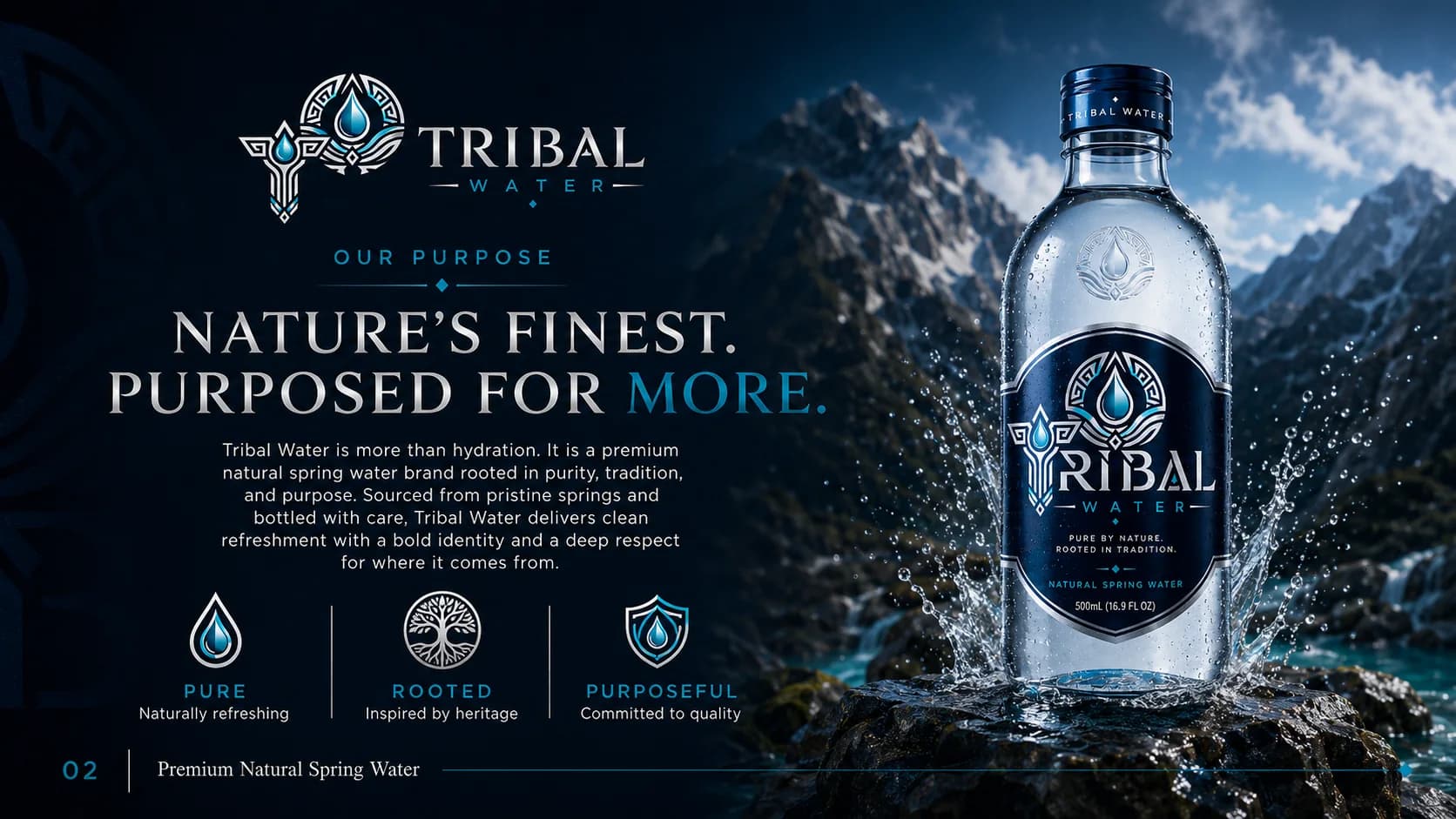
A tribe-owned consumer water brand built for hospitality, wholesale, retail, distribution, and long-term community value.
01
ORIGIN
Origin Is a Standard, Not a Story
Most water brands treat origin as decoration—a watershed name printed over a photograph of a mountain nobody visited. Tribal Water treats origin as a documentation problem first and a narrative second. Before a single word about the source appears on a label or a page, it has to survive the same review as the nutrition panel: classification confirmed under federal bottled water definitions, laboratory results on file, and language a regulator would recognize as accurate.Open market brief ↗
02
VISUAL LANGUAGE
Obsidian, Gold, Copper, Bone
The identity is built on four materials and one restraint. Obsidian black carries the field. Ceremonial gold appears sparingly—on the emblem, on a rule, on a single line of type—never as a wash. Copper handles warmth and secondary marks. Bone is the reading surface. Deep mineral tones sit underneath everything as the connective range, so the palette reads as stone and metal rather than as a color scheme.Open market brief ↗
03
PRODUCT SYSTEM
Formats Built Around How Water Actually Moves
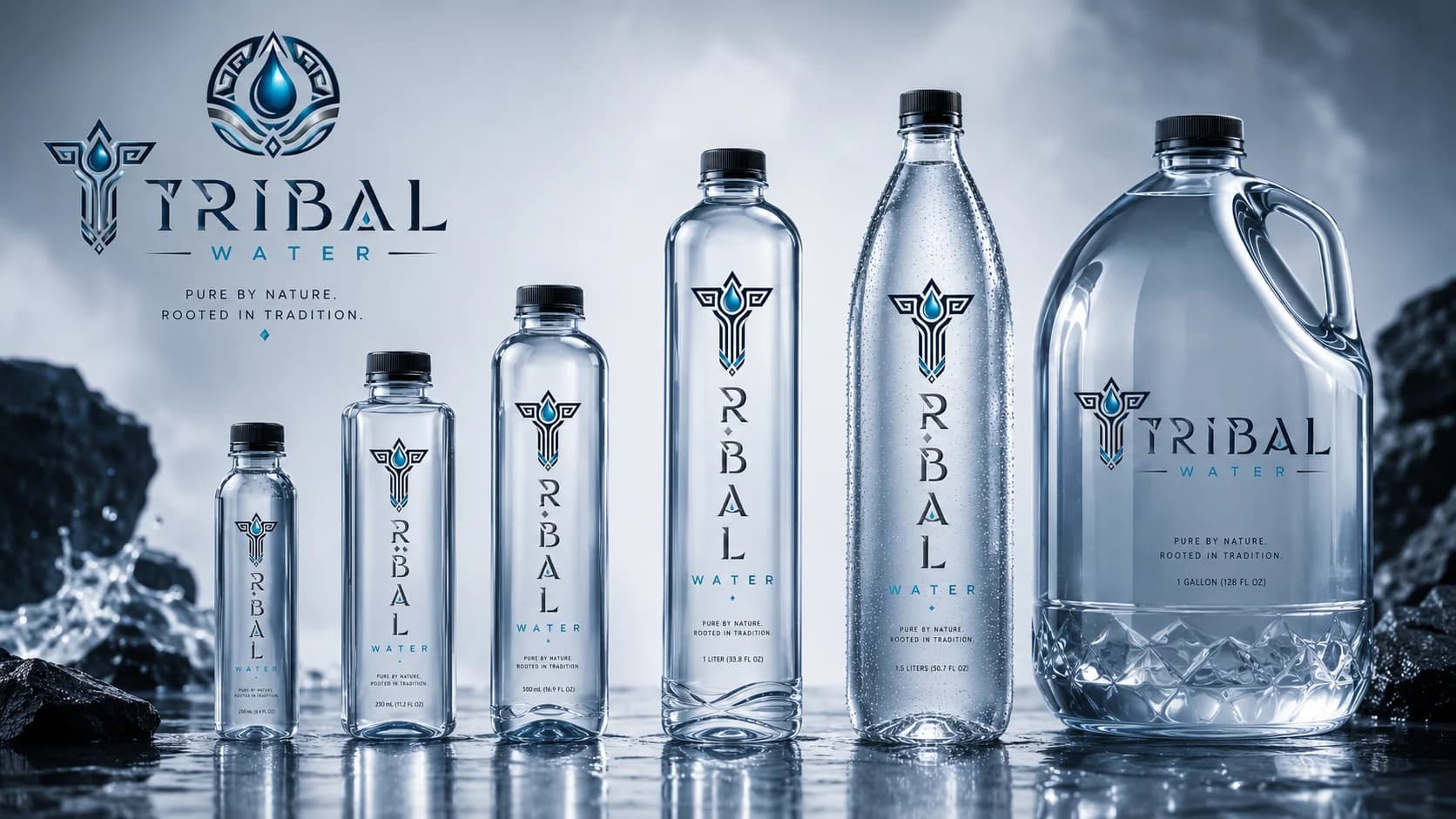
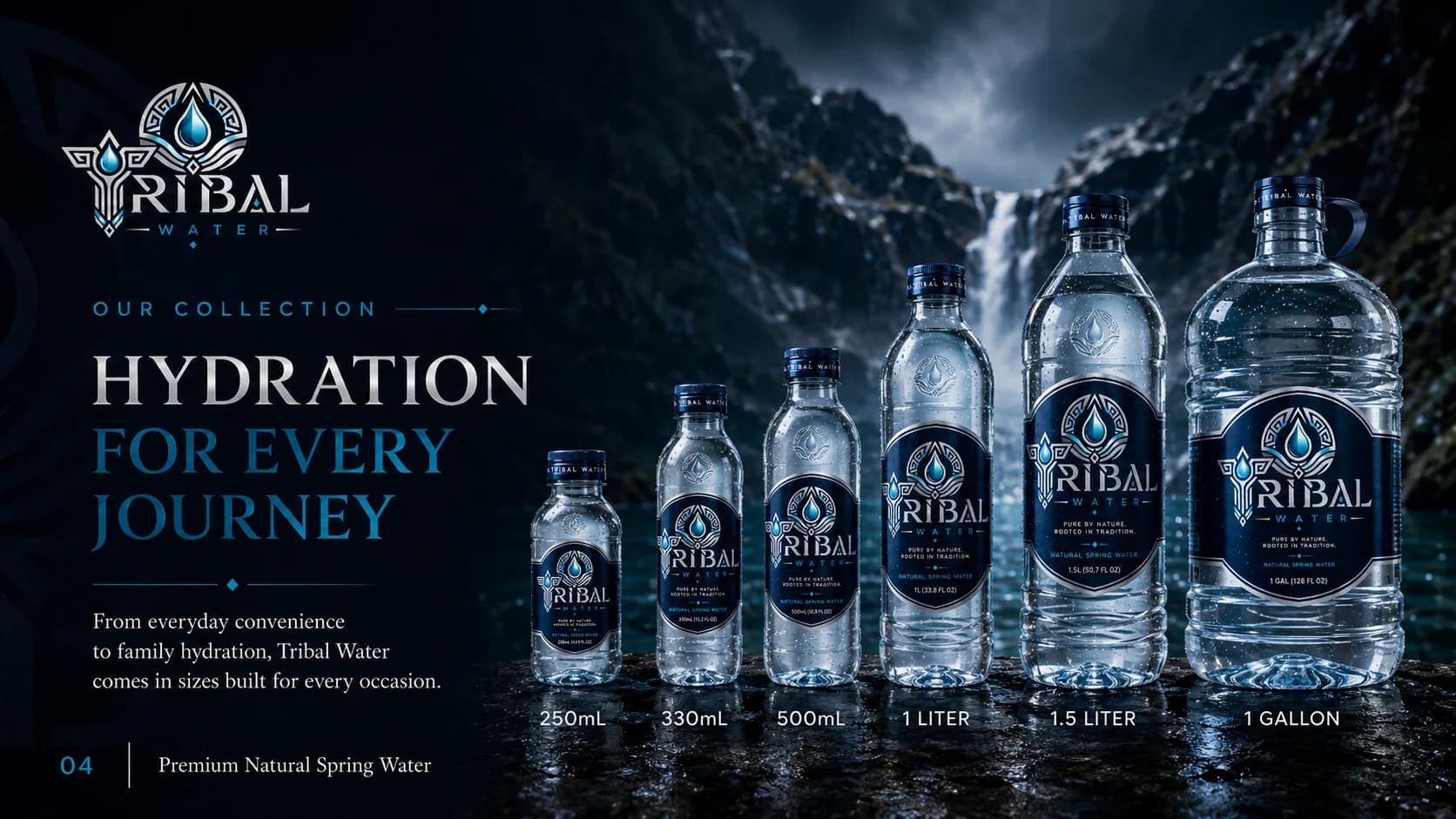
A hotel banquet floor, a fine-dining table, a convenience cooler, and a festival concession stand each want a different object, and a brand that ships one format is choosing which of those rooms it loses. The Tribal Water format program is being specified across still-water sizes that map to those environments directly: a tabletop bottle sized for service and refill, a single-serve retail format for cold-box placement, and a large-format option for meeting spaces and catering.Open market brief ↗
04
OWNERSHIP
Where the Margin Stays
The reason to build a tribally owned water brand rather than license a name to an existing bottler is straightforward: licensing returns a royalty, ownership returns the enterprise. Tribal Water is structured so the brand asset, the trademarks, the artwork, the account relationships, and the accumulated goodwill sit with the tribal enterprise rather than with a co-packer or a distribution partner. Production can be contracted. Ownership is not.Open market brief ↗
05
GO TO MARKET
Hospitality First, Then Outward
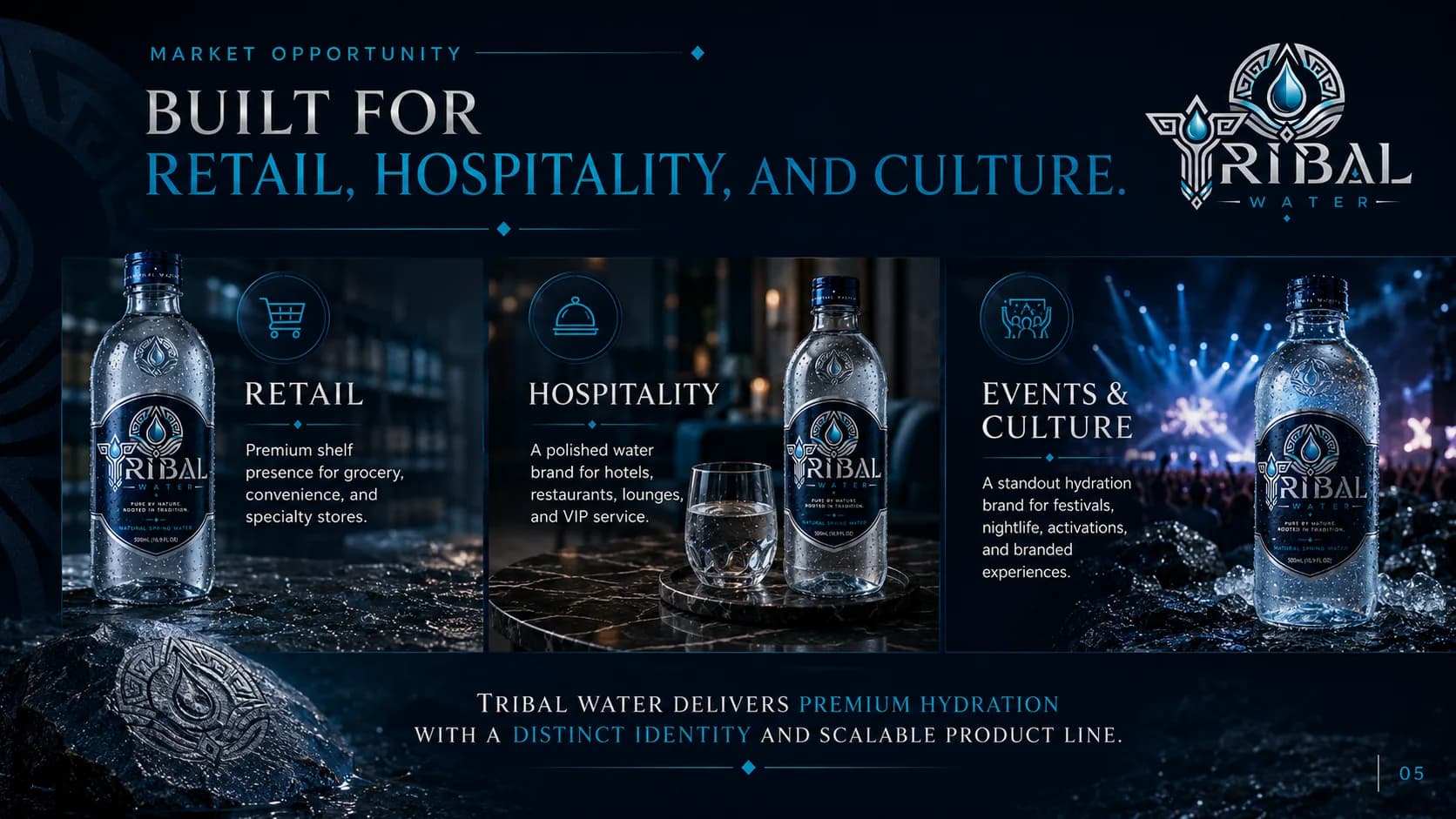
The launch sequence starts on-premise for a reason. Hospitality accounts—hotels, restaurants, conference floors, private clubs—buy on presentation and service reliability rather than on shelf price, which is the right first test for a brand whose advantage is its object and its provenance. They also produce the reference accounts and volume history that regional distributors require before granting real territory attention.Open market brief ↗
06
INTENT
What the Brand Is Being Built to Fund
The intention behind Tribal Water is that a growing consumer brand becomes a durable revenue base for the tribal enterprise that owns it, and that the enterprise directs its returns toward priorities its own leadership sets—workforce, youth programs, education, and infrastructure among them. That is the design goal, and it is the reason the ownership structure above is written the way it is.Open market brief ↗
07
SOURCE DILIGENCE
The Source Story Begins in the Technical File
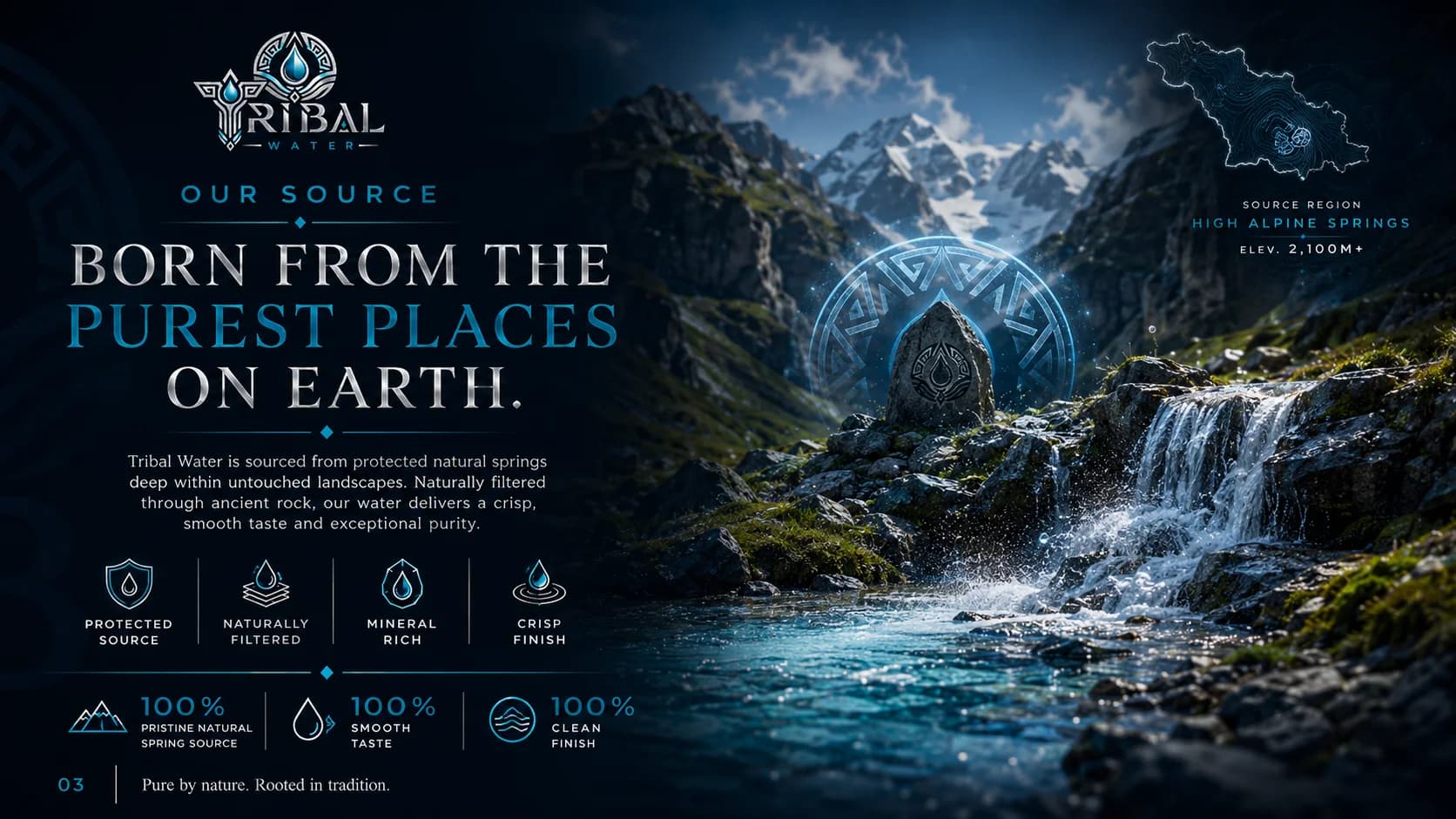
A compelling source image is not a substitute for a qualified source. Before Tribal Water identifies a spring, aquifer, region, elevation, or geological feature in public, the enterprise must be able to show what source is being used, who controls access to it, which approvals apply, how it is classified, and whether the intended production arrangement may lawfully use that description. Those questions are settled in the diligence record before they become marketing language.Open market brief ↗
08
QUALITY & COMPLIANCE
Quality Is a Release Decision, Not a Decorative Seal
Tribal Water is being developed as packaged drinking water, which means the operating standard has to cover more than the water itself. The source, treatment process, production environment, sanitation controls, containers, closures, coding, storage, shipment, and records all contribute to whether a finished lot is acceptable. The responsible production partner must operate under the requirements that apply to the product and keep the documentation necessary to support release and traceability.Open market brief ↗
09
PACKAGING ARCHITECTURE
A Format Earns Its Place by Solving a Channel Problem
The iCloud concept deck explores a family of single-serve, table-service, large-format, and gallon presentations. Those studies establish a visual direction, not a promise that every size is already manufactured or available. The commercial assortment will be narrowed through buyer demand, production compatibility, case economics, storage, freight, recyclability, and the ability to replenish consistently. A format enters the sellable catalog only after its specification and production path are approved.Open market brief ↗
10
ACCOUNT PROGRAMS
The Bottle Has to Work After It Leaves the Photograph
A hospitality or wholesale account is not complete when the artwork is approved. The buyer needs to know which format fits the service model, how many cases the location can receive and store, what lead time applies, how reorders are placed, how shortages are communicated, and who resolves quality or delivery concerns. Tribal Water treats those operating details as part of the product rather than as exceptions handled after launch.Open market brief ↗
11
DISTRIBUTION
A Territory Is an Operating Commitment, Not a Map Color
Distribution interest is evaluated by the work required to serve the market. Geography matters, but so do channel access, active accounts, warehouse conditions, vehicles, sales coverage, reporting, payment capacity, launch resources, and the ability to protect product and brand standards. A broad territory without operating depth can slow a launch more than a smaller, accountable market with clear routes and buyers.Open market brief ↗
12
PROJECT SEQUENCE
From Serious Interest to a Repeatable Program
The fastest route to launch is a disciplined sequence. An initial inquiry identifies the account type, market, intended channel, format interest, estimated demand, launch window, receiving conditions, and decision process. Tribal Water can then determine whether the request belongs in hospitality, wholesale, retail, events, distribution, or a future program—and whether enough information exists to advance.Open market brief ↗
13
FREQUENTLY ASKED
What Buyers and Partners Should Confirm Before Proceeding
Is Tribal Water already available everywhere? No. The brand is in development, territories remain subject to approval, and product availability is confirmed only for a specific item, market, account, and period. The public deck shows the intended brand and format system; it is not a live inventory list or a representation of established retail distribution.Open market brief ↗
OWN THE SOURCE • OWN THE ROUTE • OWN THE SHELF • OWN THE FUTURE •

 Tribal WaterPricing